Ragiv:Von koch 6 etapes.svg
Jump to navigation
Jump to search
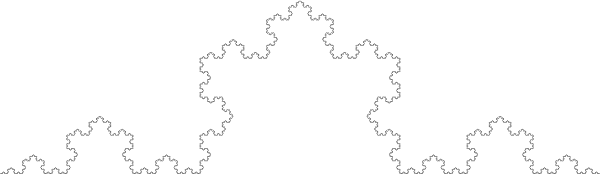
Size of this PNG preview of this SVG file: 600 × 174 pixels. Votik(s) magodadensitöfs: 320 × 93 pixels | 640 × 186 pixels | 1,024 × 297 pixels | 1,280 × 371 pixels | 2,560 × 742 pixels.
Ragiv rigik (ragiv in fomät: SVG, magodaziöbs 600 × 174, gretot: 2 KB)
Plän brefik
| Bepenam |
English: von Koch snowflake curve after 6 steps (4,097 points); initially created with Scilab, transformed into SVG by pstoedit, layout by Inkscape. New version was created by a text editor.
Français : Courbe du flocon de neige de von Koch après 6 étapes (4,097 points) ; initialement créé avec Scilab, transformé en SVG avec pstoedit, mis en forme avec Inkscape. La nouvelle version a été faite avec un éditeur de texte. |
| Dät | |
| Fon | Vobot okik |
| Lautan | Christophe Dang Ngoc Chan (cdang) |
| Däl (Dönugebön nünedi at) |
GFDL |
| Other versions | Image:Von koch 1 etape.svg, Image:Von koch 2 etapes.svg, Image:Von koch 3 etapes.svg, Image:Von koch 4 etapes.svg, Image:Von koch 5 etapes.svg, Image:Von koch 6 etapes.svg, Image:VonKoch.svg |
| SVG genesis |


Scilab source
 |
This media was created with Scilab, a free open-source software. Here is a listing of the Scilab source used to create this file. |
English: English version by default.
Français : Version française, si les préférences de votre compte sont réglées (voir Special:Preferences).
Iterative source code
// ******************************
// *                            *
// * "Snowflake" von Koch curve *
// *                            *
// ******************************

clear;
clf;

// **************
// * constants *
// **************

n = 6;
// number of steps
// limited to 9 (262 145 points), otherwise the stacksize must be changed
// 6 steps (4 097 points) are enough for a good rendering
N = 4^n+1; // amount of points
sin_soixante = sqrt(3)/2; // sin(60°)
l = 1; // length of the initial line (arbitrary unit)

// ******************
// * initialisation *
// ******************

ycourbe = [zeros(1,N)];
ycourbe1 = ycourbe;

// *************
// * functions *
// *************

function [xx, yy] = etape(x, y)

  // from a line [(x(1),y(1)) ; (x(2),y(2))]
  // make the line [(xx(1),yy(1)) ; (xx(2),yy(2)) ; (xx(3),yy(3))]
  // x and y are 2-cells tables, the ends of the basis line
  // xx and yy are 3-cells tables
  // the edges of the equilateral triangle

  xu = (x(2)-x(1))/3;
  yu = (y(2)-y(1))/3;
  // third of the basis line vector

  xv = 0.5*xu - sin_soixante*yu;
  yv = sin_soixante*xu + 0.5*yu;
  // vector turned by +60°

  xx(1) = x(1)+xu; yy(1) = y(1)+yu;
  xx(3) = x(2)-xu; yy(3) = y(2)-yu;

  xx(2) = xx(1) + xv;
  yy(2) = yy(1) + yv;
endfunction

function [xkoch, ykoch] = vonkoch(x, y, n)
  // builds the curve
  // initialisation
  xkoch = x;
  ykoch = y;
  xkoch1 = x;
  ykoch1 = y;
  for i=1:n
    jmax = 4^(i-1);
    // number of lines at the beginning of the step i
    for j=1:jmax/2+1
      // we work with two points which indices are j and j+1 (line #j)
      // thanks t the symmetry, we work with a half curve
      decalage = (j-1)*4;
      // the new points shift the next points by this offset
      x_init = xkoch(j:j+1);
      y_init = ykoch(j:j+1);
      // line #j
      [x_trans, y_trans] = etape(x_init,y_init);
      // transformed line
      xkoch1(decalage+1) = x_init(1); xkoch1(decalage+5) = x_init(2);
      ykoch1(decalage+1) = y_init(1); ykoch1(decalage+5) = y_init(2);
      for k=1:3
        xkoch1(k+decalage+1) = x_trans(k);
        ykoch1(k+decalage+1) = y_trans(k);
        // values put in the global vector
      end
    end
    xkoch = xkoch1; ykoch = ykoch1;
  end

  for i=1:4^n
    ykoch(N-i+1) = ykoch(i);
    xkoch(N-i+1) = l-xkoch(i);
    // 2nd half-curve
  end
endfunction

// ****************
// * main program *
// ****************

xcourbe(2) = l;
[xcourbe,ycourbe] = vonkoch(xcourbe,ycourbe,n);

// drawing the curve

xpoly(xcourbe,ycourbe)
isoview(0,l,0,l*sin_soixante/3)
The following code can be added to directly generate the file (the SVG export was not implemented at the time the file was created).
// saving the file

name = "von_koch_"+string(n)+"_steps.svg";
xs2svg(0, name)
Recursive source code
The code is more compact but the execution is slower, and does not generate the table of values.
//============================================================================
// name: von_koch.sce
// author: Christophe Dang Ngoc Chan
// date of creation: 2012-10-23
// dates of modification:
//    2013-07-08: quotes ' -> "
//    2013-07-2: vectorisation of the calculations
//----------------------------------------------------------------------------
// version of Scilab: 5.3.1
// required Atoms modules: aucun
//----------------------------------------------------------------------------
// Objective: draws the von Koch's "snowflake"
// Inputs: none (parameters are hard coded)
// Outputs: graphical window with a curve; SVG file
//============================================================================

clear;
clf;

// *************
// * constants *
// **************

n = 6;
// number of steps
// limited to 9 (262 145 points), otherwise the stacksize must be changed
// 6 steps (4 097 points) are enough for a good rendering
sin_soixante = sqrt(3)/2; // sin(60°)
l = 1;
// length of the initial line (arbitrary unit)

// ******************
// * initialisation *
// ******************


// *************
// * functions *
// *************

function [] = vonkoch(A, B, i)
    u = (B - A)/3 ; // third of the AB vector
    v = [0.5*u(1) - sin_soixante*u(2) ; sin_soixante*u(1) + 0.5*u(2)] ;
    // vector turned by +60°
    C = A + u ;
    D = C + v ;
    E = B - u ;
    // points of the line
    if i == 1 then
        // drawing the smallest segments
        x = [A(1) ; C(1) ; D(1) ; E(1) ; B(1) ];
        y = [A(2) ; C(2) ; D(2) ; E(2) ; B(2) ];
        xpoly(x, y, "lines")
    else
        j = i - 1 ;
        vonkoch(A, C, j);
        vonkoch(C, D, j);
        vonkoch(D, E, j);
        vonkoch(E, B, j);
        // recursive call
    end
endfunction

// ****************
// * main program *
// ****************

beginning = [0;0] ;
ending = [l;0] ;
vonkoch(beginning, ending, n)

isoview(0,l,0,sin_soixante*l)

// Saving the file

name = "von_koch_"+string(n)+"_steps.svg" ;
xs2svg(0, name)
Dälastad
I, the copyright holder of this work, hereby publish it under the following licenses:

|
Däl pagevon ad kopiedön, seagivön e/u votükön dokümi at ma Dälazöt ad Dokümam Libik: GNU, Fomam: 1.2 u nulikum fa el Free Software Foundation (Stitod: Nünömaprograms libik); nen diläds nevotükovik, nen vödems tegapada balid, e leigo nen vödems tegapada lätik. Kopied dälazöta pekeninon in diläd: Dälazöt ad Dokümam Libik: GNU panemöl. |
  
|
Nüned at pegebidükon bai dälazöt: ‚Creative Commons’ Attribution-Share Alike 3.0 Unported. | |
| ||
| This licensing tag was added to this file as part of the GFDL licensing update. |
Dalol välön dälazöti ma plüd ola.
Jenotem ragiva
Välolös däti/timi ad logön ragivi soäsä äbinon ün tim at.
| Dät/Tim | Magodil | Mafots | Geban | Küpet | |
|---|---|---|---|---|---|
| anuik | 12:22, 2018 febul 21id | | 600 × 174 (2 KB) | wikimediacommons>Cdang | even values and indentations |
Geb ragiva
Pad sököl gebon nünedi at:
